

You’ve rolled an ankle, jammed a finger or taken a knock on the sporting field. It hurts, it’s starting to swell and now comes the inevitable question:
Is it broken, or is it just a sprain?
Unfortunately, it isn’t always easy to tell.
Fractures and sprains can cause surprisingly similar symptoms, including pain, swelling, bruising and difficulty using the injured area. And despite some common myths, being able to move a joint or even walk on an injured leg it doesn’t necessarily rule out a fracture.
The good news is that there are some signs that can help you decide what to do next.
At Activate Physiotherapy, we assess acute injuries in adults and children at our Tingalpa and Stafford clinics in Brisbane, including injuries where a fracture is suspected.
What is the difference between a fracture and a sprain?
A fracture is a break or crack in a bone. Fractures can range from small or relatively stable cracks through to more significant injuries where the bone has moved out of its normal position.
A sprain is an injury to a ligament, the strong connective tissue that helps join bones together and stabilise a joint. Sprains can range from a mild stretching of the ligament to a partial or complete tear.
Both injuries can happen through very similar mechanisms, such as:
- rolling an ankle;
- falling onto an outstretched hand;
- twisting a knee or wrist;
- having a finger bent backwards;
- colliding with another player; or
- receiving a direct blow during sport.
That overlap is one reason symptoms alone don’t always give you a definite answer.
What are the signs of a fracture?
Symptoms vary depending on the bone and severity of the injury, but a fracture may cause:
- immediate pain following an injury;
- swelling;
- bruising;
- tenderness directly over a bone;
- difficulty putting weight through the injured area;
- difficulty moving or using the limb normally;
- pain when pressure is applied to the bone;
- an unusual shape or obvious deformity; or
- in more serious injuries, an open wound associated with the fracture.
Does a fracture always cause severe pain?
No.
Some fractures are extremely painful, while others can initially feel much less dramatic.
Small, stable or non-displaced fractures may not produce the severe pain people associate with a “broken bone”. This is one reason it can be risky to judge the seriousness of an injury based on pain alone.
What are the signs of a sprain?
A sprain can also cause:
- pain;
- swelling;
- bruising;
- tenderness around a joint;
- reduced movement;
- difficulty putting weight through the area; and
- a feeling that the joint is unstable or unreliable.
With more significant ligament injuries, the pain, bruising and swelling can be substantial, sometimes making a severe sprain look very similar or even worse than a fracture.
Fracture vs sprain: can you tell from the symptoms?
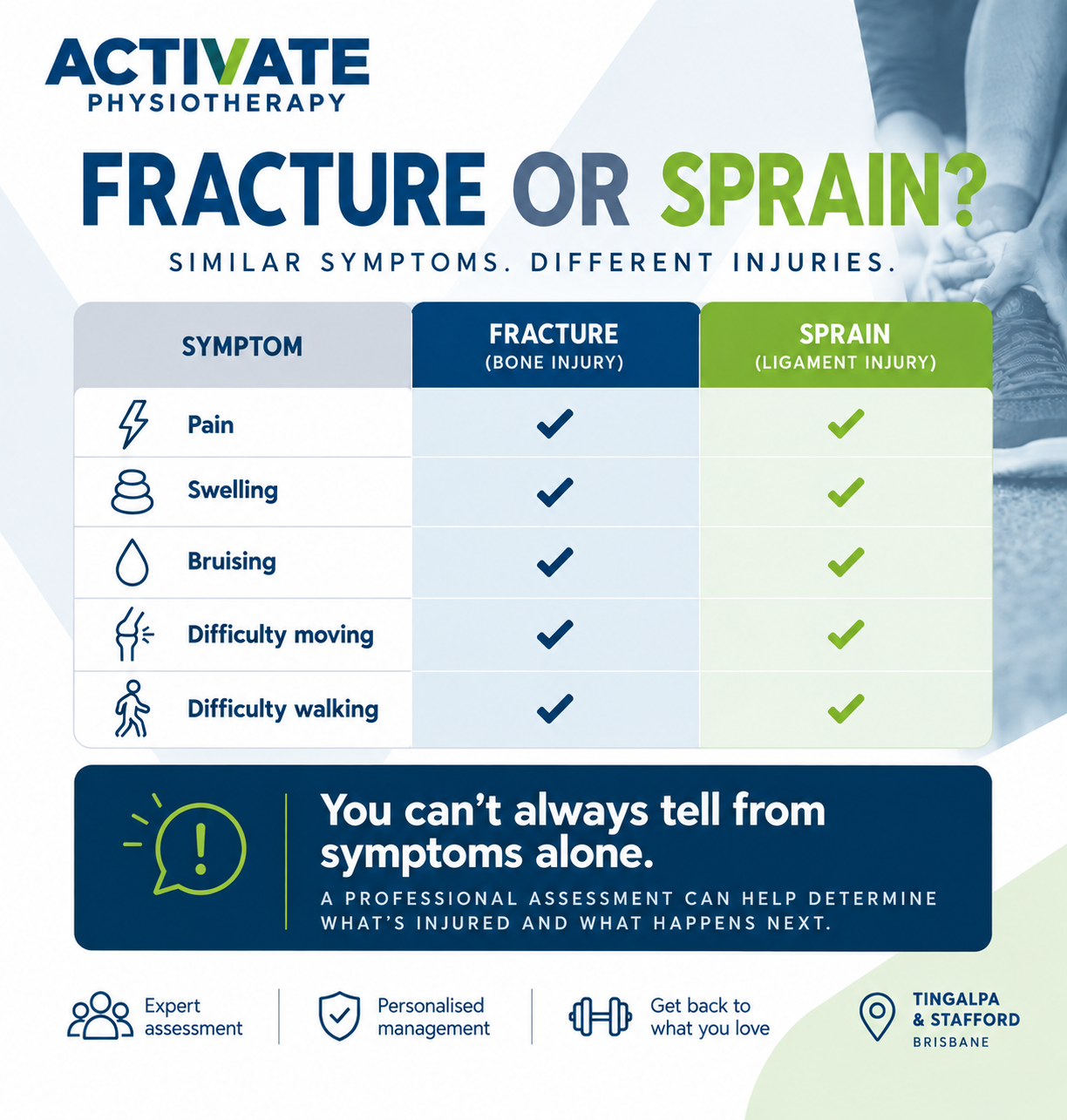
Sometimes there are clues, but you can’t always reliably tell without an assessment and, when indicated, imaging such as an X-ray.
A useful comparison is:
SYMPTOM |
FRACTURE | SPRAIN |
| Pain | Common | Common |
| Swelling | Common | Common |
| Bruising | Common | Common |
| Difficulty Moving | Common | Common |
| Difficulty Weight-bearing | Common | Common |
| Tenderness Directly over a bone | More Concerning for a Fracture | Can Occur |
| Joint Instability | Possible | More commonly associated with ligament injury |
| Visible Deformity | May Occur | Less Typical |
| Confirmed on XRay | Often* | Usually Not |
*Not every fracture is immediately obvious on a standard X-ray, and the appropriate imaging depends on the injury.
The important point: swelling or bruising alone can’t tell you whether an injury is fractured or sprained.
Can you still move a broken bone?
Yes. Being able to move the injured area does not automatically mean it isn’t broken.
This is a particularly common misconception with fingers, wrists, ankles and feet.
Movement depends on several structures, including muscles and tendons. A fracture doesn’t necessarily stop those structures from working, particularly if the fracture is stable or hasn’t significantly changed the alignment of the bone.
So:
“I can move it, so it can’t be broken” isn’t a reliable test.
Can you walk on a fractured ankle or foot?
Sometimes, yes.
Some people can still put weight through an ankle or foot despite having a fracture. Conversely, a severe ankle sprain can make weight-bearing extremely difficult.
So while an inability to walk after an injury is certainly a reason to seek assessment, being able to walk doesn’t completely rule out a fracture.
Does lots of swelling mean it is broken?
Not necessarily.
Both fractures and soft-tissue injuries can produce significant swelling.
Rapid or substantial swelling following an injury tells us that the area has been injured, but the amount of swelling alone doesn’t tell us which structure has been damaged.
The location of the swelling, mechanism of injury, areas of tenderness and ability to use the injured area all help form the clinical picture.
What about bruising?
Again, bruising can happen with both fractures and sprains.
Bruising occurs when small blood vessels are damaged and blood collects beneath the skin. This can happen when a bone fractures, but it can also occur when ligaments and other soft tissues are injured.
Significant bruising is therefore worth paying attention to, but it doesn’t prove that a bone is broken.
When should you get an injury assessed?
Consider having an acute injury assessed if there is:
- significant or increasing pain;
- substantial swelling or bruising;
- tenderness directly over a bone;
- difficulty walking or putting weight through the area;
- difficulty using the hand, arm or injured limb normally;
- reduced movement;
- an obvious change in shape;
- symptoms that aren’t settling as expected; or
- simply uncertainty about how significant the injury might be.
For parents, it can be particularly difficult to determine how serious a child’s sporting injury is especially when the weekend’s game is approaching and you’re getting conflicting advice from the child, coach, Google and the parents’ group chat.
An appropriate assessment can help determine what has been injured and what should happen next.
Do I need an X-ray?
Not every injury needs an X-ray.
A physiotherapist can assess the mechanism of injury, location of pain and tenderness, swelling, movement, function and ability to bear weight, along with other clinical findings, to determine whether further investigation may be appropriate.
Where a fracture is suspected, imaging may be recommended to help confirm the diagnosis and determine the next stage of management.
What should I do if I think it might be fractured?
If you think an injury may be fractured, avoid repeatedly “testing it out” or trying to push through significant pain.
Protect the injured area and arrange an appropriate assessment.
If there is obvious deformity, an open injury, severe uncontrolled pain, altered sensation, concerning changes in circulation, a significant head or spinal injury, or other signs of a serious injury, seek urgent medical care.
If you’re not sure if your injury is a sprain or fracture it is likely that it is not a medical emergency and therefore doesn’t require emergency hospital care. Assessment and treatment outside an emergency department with your Physiotherapist or GP is likely to be a better option.
Can a physiotherapist assess a suspected fracture?
Yes. Physiotherapists are trained to assess musculoskeletal injuries and identify clinical signs that may indicate a fracture or other injury requiring further investigation or referral.
At Activate Physiotherapy, our physiotherapists can assess the injury and determine the appropriate next steps. Depending on the findings, that might include imaging, immobilisation, referral for further medical or orthopaedic assessment, or treatment and rehabilitation of a soft-tissue injury.
What is Activate Physiotherapy’s Private Fracture Clinic?
Activate Physiotherapy’s Private Fracture Clinic in Brisbane provides another pathway for appropriate fractures and suspected fractures that don’t require emergency hospital care.
Our fracture management service combines assessment, appropriate immobilisation and rehabilitation, helping patients move from the initial injury through to recovery.
With clinics at Tingalpa and Stafford, families can have an acute musculoskeletal injury assessed and, where appropriate, managed within the clinic rather than automatically assuming every suspected fracture requires hours in an emergency department.
Not sure whether it’s fractured or sprained?
Book an acute injury assessment with Activate Physiotherapy at Tingalpa or Stafford, and we can help determine what’s happened and what you should do next.

Frequently Asked Questions About Fractures and Sprains
How can you tell if an injury is a fracture or sprain?
It can be difficult to tell from symptoms alone because both fractures and sprains can cause pain, swelling, bruising and difficulty using the injured area. Tenderness directly over a bone, significant loss of function or deformity may increase concern about a fracture, but assessment and sometimes imaging are needed to determine the diagnosis.
Can you move something if it is broken?
Yes. Some fractures still allow movement, particularly stable or non-displaced fractures. Being able to move a finger, wrist, ankle or other injured area does not rule out a fracture.
Can you walk on a broken ankle?
Sometimes. Certain fractures still allow some weight-bearing, while severe sprains can make walking impossible. The ability to walk shouldn’t be used on its own to determine whether an ankle is fractured.
Is bruising a sign of a fracture?
It can be, but bruising also commonly occurs with sprains and other soft-tissue injuries. Bruising alone can’t confirm whether a bone is fractured.
Do all fractures need an X-ray?
Not necessarily, and the appropriate type of imaging depends on the injury. A clinical assessment can help determine whether imaging is indicated.
Should I go to emergency for a suspected fracture?
Not every suspected fracture requires an emergency department. However, significant trauma, obvious deformity, open injuries, severe uncontrolled pain, circulation or sensation changes, or other serious symptoms require urgent medical assessment. If you’re not sure if its just a sprain or a fracture it is likely an uncomplicated fracture and not a medical emergency which means your injury is best suited to assessment and treatment through a service such as Activate Physiotherapy’s Private Fracture Clinic.
Recent Comments